Marketing · Marketing and landing pages
Why advertising needs a suitable landing page
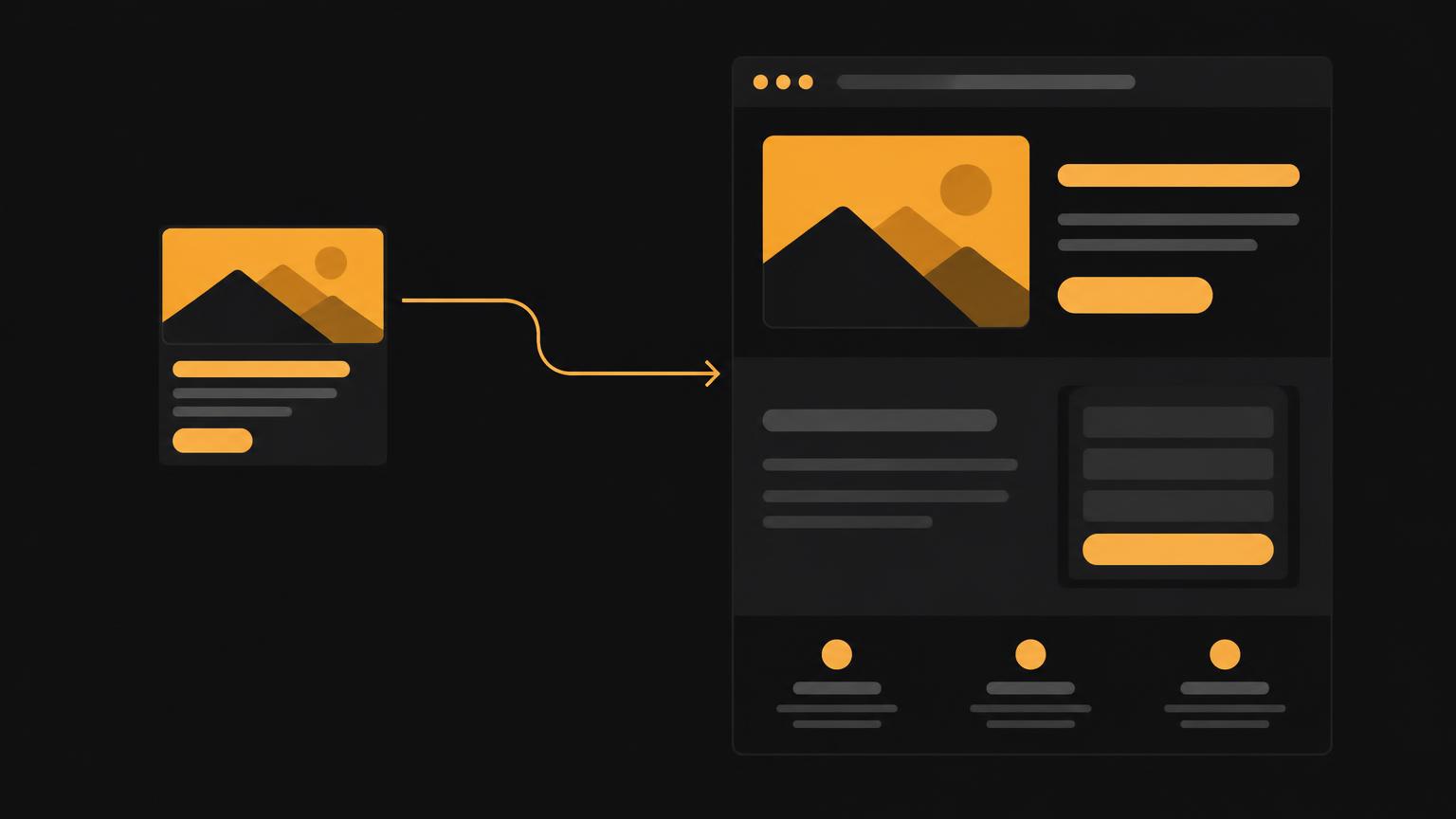
An ad can spark interest. Whether that leads to a serious conversation is not decided in the advertising account alone. After clicking, a person checks whether the advertised offering actually suits their situation. If that connection is missing, they must search, compare and make assumptions themselves. A suitable landing page removes this unnecessary effort.
This does not necessarily mean an additional website. An existing service page can also be a good destination if it follows through on the expectation created by the ad and offers a clear next step. The entire enquiry journey matters: from the initial promise through useful information to a clear confirmation after submission.
1. The advertising promise must continue on the landing page
People click with a specific expectation. An ad for a particular service calls for a different response from a general company introduction. If language, offering and audience do not match, the journey breaks down. The landing page should therefore make clear early on who the offering is for, which need it addresses and what can happen next.
Before designing the page, write a simple handover sentence: someone clicking this ad wants the following page to answer this question. This sentence helps prioritise content. It also prevents a single campaign trying to explain consultancy, job vacancies, company history and every service at once. A clear selection is more helpful than the largest possible volume of content.
Google includes landing page experience as a component of Quality Score for search campaigns. The official explanation of Quality Score provides a basis for assessment, not a promise of better results. Quality Score is a diagnostic tool. Your own informed review must also establish whether the actual offering and enquiry route meet expectations.
| Ad element | Corresponding landing page element | Typical mismatch |
|---|---|---|
| Specific service | Explanation of that exact service | General homepage without guidance |
| Intended audience | Relevant requirements and examples | Copy aimed at a different customer group |
| Promised next step | Contact option with consistent wording | Unexpected registration |
| Region or service area | Clear regional information | Unclear availability |
2. Make the heading, offering and benefits specific
The main heading should provide direction, not merely attract attention. A person must be able to recognise whether they are in the right place without first playing a video or searching several sections. Reflect the core of the ad and clarify the offering underneath. Avoid sweeping promises that neither explain nor define your service.
Describe benefits from the intended audience’s perspective. Processes and responsibilities may be crucial to a specialist in charge. Senior management may focus more on organisational workload. This does not mean you need a separate page for every role. First check whether a clear sequence of information can adequately answer different questions.
Limitations are also part of the offering. State relevant requirements, the intended service scope and any information still needed before an assessment. These details help prospective customers evaluate it. You do not need to publish a lengthy contractual description. What matters is that the ad does not suggest simplicity while the landing page only reveals significant conditions immediately before submission.
3. Verifiable content builds trust
Trust cannot be replaced by displaying as many badges as possible. Explain clearly who delivers the service, how working together begins and which specialist information is needed. Genuine images, identifiable contacts and a credible process can help. Only use supporting evidence that exists, is current and has been approved for publication.
A description of your approach is often more helpful than an unsupported claim such as leading quality. Show, for example, which questions an initial discussion will address and what decision follows. If you use references, you need the appropriate rights and approvals. Invented testimonials, generic rating symbols and unsubstantiated results do not belong on the page.
Advertising content and landing pages should also be visually consistent. An image may attract interest, but it must support the actual offering. If an ad shows personal advice but the landing page contains only an anonymous product directory, the promised connection is missing. Preparation guidance is available in the article on advertising content and the advertising content service.
4. Choose a landing page to match the campaign objective
An awareness campaign does not need the same landing page as a campaign seeking a specific enquiry. Someone still trying to understand a problem needs guidance and informed answers. Someone already seeking a solution wants to compare service scope, requirements and contact options. Define the next useful step first, then design the relevant section.
The following interactive example provides local guidance: select an audience and an advertising promise, then compare three possible landing pages. A general company page, a specific service page and an advice page serve different purposes. The most relevant continuation in content terms is not automatically the best commercial option. The demo is not a real ad and transmits no data.
When comparing, look beyond the heading. Check whether the remaining content fulfils the promise and whether the desired action suits the decision stage. An immediate enquiry is not appropriate in every situation. Sometimes a clear explanation is the better next step. The article Meta Ads or Google Ads covers channel selection.
- Home pageWelcome to Muster AGMay not match the ad
- Performance sideBathroom renovation in your areaMatches the ad's message
- Offer pageProperty maintenance contractMay not match the ad
5. Plan calls to action and forms as one continuous journey
A call to action should describe as clearly as possible what happens after the click. An invitation to enquire about a project differs from an appointment that can be booked immediately. Use consistent wording at important contact points and explain which information is needed. A prominent button helps little if the next page asks for a different action.
Only ask for information in the form that is useful for the next processing step. Required fields should make sense. Explain why unusual details are needed and provide understandable error messages. Technical testing must also show whether entered information is preserved after an error and whether the form works with a keyboard and on small screens.
After submission, the person needs an unambiguous confirmation. They should understand whether their message arrived and what happens next operationally. Only state response times that can genuinely be met internally. Also check receipt at the responsible destination. A visible confirmation alone does not prove the enquiry has reached the intended workflow.
If you would like to review your enquiry journey, you can discuss your landing page and advertising with us together.
Send a non - binding enquiry6. Test mobile use and loading time throughout the real journey
Many problems only become apparent on a small screen. A heading may obscure the offering, a fixed contact panel may cover the form, or an image may take up unnecessary space. Test the journey from ad to confirmation at different screen widths. The key question is not just whether everything fits, but whether the process is understandable and usable.
Large media files, unnecessary scripts and poorly prepared images can delay page loading. Optimise image dimensions and file formats for their display. Defer non-essential content without hiding important information. Technical measurement is useful but cannot replace a practical test on a mobile device with a less-than-ideal connection.
Assess distractions deliberately. Navigation can provide trust and orientation while also leading away from the specific offering. There is therefore no universal rule to remove all links. Keep necessary information and make the main route clearly visible. For structural problems, a website analysis can identify which changes make sense first.
7. Improve an existing page or create a dedicated landing page
An existing service page is often sufficient if the audience, offering and contact route already align. First check which content or technical gaps actually exist. A new page creates additional maintenance work. Copy, contact details and service descriptions must remain consistent later, so different versions of the same offering do not become outdated side by side.
A dedicated landing page can make sense when a campaign addresses a clearly defined audience or a particular question. It allows a focused sequence of information. At the same time, you need responsibilities for design, approval, technical management and later updates. The decision should follow communication needs, not simply the fact that a new campaign is being set up.
Before implementation, establish who provides service descriptions, images, usage rights, contacts and approvals. The client must also confirm factual accuracy and the actual availability of the offering. If fundamental adjustments are needed, they can be scoped as part of a website improvement. A complete rebuild is not automatically required.
8. Clarify measurement, budgets and approvals before launch
A click is not yet an enquiry. A submitted message, in turn, is not automatically a relevant business opportunity. Define which action to observe and how you will assess its quality internally. Align technical events with the actual process. A click on the submit button must not count as confirmed receipt if transmission subsequently fails.
Tracking may only be used with appropriate consent and a privacy solution. Missing consent, technical restrictions and different devices limit measurement. Google explains different ways to track conversions. Check which features are available and suitable in the specific account before implementation. Server-side methods do not bypass required consent either.
The advertising budget goes to the platform and must be separated from strategy, content, page implementation and management. Platform costs and advertising spend are paid directly or according to the account setup; arrangements must be confirmed before the project. Results depend on factors including the offering, market, competition, budget, audience, advertising content, landing page and measurement. An improved page does not guarantee enquiries.
Use a shared list for approval rather than scattered individual messages. Identify open questions and responsible people. The article conversion tracking explained simply explores measurement fundamentals. Plan to review actual enquiry quality after launch without prematurely drawing general conclusions from individual responses.
Practical approval checklist before campaign launch
- The ad and heading address the same audience.
- The offering, limitations and next step are clear.
- Images and supporting evidence have been checked for accuracy and approved.
- The form, error messages and confirmation have been tested.
- Mobile display and loading behaviour have been checked.
- Consent, measurement events and responsibilities are settled.
- The advertising budget and service scope have been confirmed separately.
Also check handovers between the people involved. Whoever approves ads should see the final landing page, not just an older draft. Whoever manages the form needs to know the advertised service and the wording used for contact. Otherwise, technically functioning steps may fail to connect organisationally. Document the approved version and identify someone responsible for later changes.
After an adjustment, go through the entire journey again yourself. Open the intended link, read the page from the audience’s perspective and send a clearly labelled test enquiry. Check its receipt and remove test data using your designated procedure. This practical acceptance check does not replace ongoing monitoring but provides a shared foundation for launch. Record remaining limitations rather than hiding them behind blanket approval.
Summary
- The landing page clearly follows through on the specific advertising promise.
- The offering, benefits and evidence must suit the audience.
- Forms and enquiry confirmations belong in campaign checks.
- An existing service page may be sufficient.
- Measurement requires appropriate consent and a privacy solution.
Frequently asked questions
Does every ad need its own landing page?
No. Several ads can lead to the same page if expectations and the offering align. A dedicated page is particularly worth considering for substantially different needs.
Can the homepage serve as a landing page?
Yes, if it makes the advertised offering immediately clear. If prospective customers must first search for the service, a more relevant subpage is usually worth considering.
How many fields should the form have?
There is no universal number. What matters is which details are genuinely needed for the next processing step and can be clearly justified.
Must navigation be removed?
Not as a general rule. Balance orientation and necessary information against unnecessary distraction, and assess the specific enquiry journey.
Is tracking without consent envisaged?
No. The measurement described here requires appropriate consent and a privacy solution. Have the specific technical and organisational implementation professionally assessed.
Will a new landing page definitely improve results?
No. A new page alone does not guarantee success. Your offering, demand, competition, advertising content and measurement also influence the assessment.
Sources
- Quality Score for search campaigns – Google Ads HelpGoogle · checked on 2026 - 11 - 05
- Different ways to track conversions – Google Ads HelpGoogle · checked on 2026 - 11 - 05
Back to the top of the article