Marketing · Marketing · Choosing a channel
Meta Ads or Google Ads: which advertising suits your business?
One person is actively searching for a service in their area. Another discovers an offer they did not previously know about while browsing their feed. Both may go on to make an enquiry. However, their starting points differ. This is where a meaningful comparison between Google Ads and Meta Ads begins.
Do not base your decision solely on a platform’s popularity or individual costs per click. Consider how people discover your offering, what content you can provide and what next step you expect interested people to take. This article helps you assess the requirements of both channels objectively, without declaring either platform the overall winner.
Search and discovery have different starting points
With search ads through Google Ads, users enter a search term. The ad can match a question they have already formulated or a specific need. This is particularly useful when people can clearly describe your offering. A search does not, however, mean that someone wants to buy immediately. Similar-sounding terms may also reflect searches for information, comparisons or job vacancies.
Meta Ads appear on platforms including Facebook and Instagram. People often encounter them while doing something else. The ad needs to explain why the offering might be relevant to them at that moment. A recognisable problem, a clear example of how something is used or a good explanation can make this introduction easier. Attention alone, however, is not a reliable business result.
This comparison describes typical starting points, not the platforms’ entire range of options. Google Ads includes other campaign types and advertising environments. Meta can also reach people who already know a brand. Available formats, placements and settings must be checked before implementation. Your choice of channel should therefore always relate to the specific campaign you are planning.
Assess demand, audience and purchasing decisions together
First, ask whether your customers are actively looking for a solution. If they use established terms, you can build a search campaign around relevant topics. If the problem is familiar but your solution is not, people may need an explanation first. A visual introduction can then help develop interest. This does not replace an assessment of actual demand.
Do not describe your audience solely in terms of age or location. What matters is the reason for their interest, their role in the decision, their existing knowledge and any potential objections. Someone who needs an urgent repair makes decisions differently from a team comparing long-term services. For business offerings, several people may also be involved in the decision. A single ad can rarely cover this entire process.
Use what you have already learnt from consultations and enquiries. Which questions keep coming up? What terms do interested people use themselves? What makes them decide against proceeding? A marketing analysis can organise this information. It provides a stronger foundation than an audience profile based entirely on assumptions.
Put products, services and local offerings in context
A product with a clear visual appeal can often be explained through its use, material or an everyday situation. For a service, the way you work, the requirements and trust are often more important. Both types of offering can be advertised on either platform. What matters is whether the ad creates a clear expectation and the landing page follows through on it.
Local offerings also involve accessibility, the actual service area, language and available appointments. A geographical setting does not replace a practical assessment of where you can reliably provide your services. Also establish whether people live in the intended location, work there or are only searching there temporarily. Check which location options are available and how they work before implementation.
Offerings that need more explanation require an appropriate intermediate step. This could be a clear service description, an overview of the process or an initial way to get in touch. Asking for a firm commitment immediately, while important questions remain unanswered, makes it harder for people to take the first step. A longer purchasing decision therefore calls for a well-planned sequence of information, rather than automatically favouring or ruling out a particular channel.
A comparison reveals requirements, not a winner
Look beyond the interfaces of the advertising accounts. The overview below sets out typical requirements for a search campaign and a campaign in the Meta feed. Combining them only makes sense when each has a clearly defined role and sufficient resources are available.
| Area to assess | Meta Ads | Google search ads | Combination |
|---|---|---|---|
| Starting point and behaviour | Discovery while viewing content | Active searches for a topic | Plan discovery and subsequent searches separately |
| Content required | Illustrative images, videos and clear copy | Search terms and relevant ad copy | Consistent messaging in distinct formats |
| Landing page | An introduction and explanation suited to existing knowledge | An answer to the specific search intent | Appropriate introductions for different expectations |
| Measurement | Assess the target action and quality in context | Review search terms, the target action and quality | Consider overlaps and combined results |
To prepare for a search campaign, you can refine keyword ideas in Keyword Planner. Tools like this provide pointers, not proof that enquiries will follow. Always assess terms in relation to your offering, your region and the content of the intended landing page.
Ad content and landing pages must fulfil the same expectation
On Meta, the message often needs to make sense without a preceding search query. Good images and videos therefore do more than show an attractive subject: they explain the context. What is being offered? Who is it for? What is a sensible next step? Plan variations with different introductions, without using unverifiable claims or artificial time pressure.
With Google search ads, the chosen search term and the message in the ad copy are closely linked. A generic ad covering very different needs can seem unclear. Align topics, copy and landing pages. Information about Google Ads helps you understand the potential scope of work; specific features must be checked before implementation.
On a mobile phone, the landing page needs a clear heading, understandable information and an appropriate way to enquire. An ad for a particular service should not lead to a page where that service is difficult to find. The article on choosing the right landing page explains this connection in more detail. You must provide the necessary photos, specialist statements and approvals in good time.
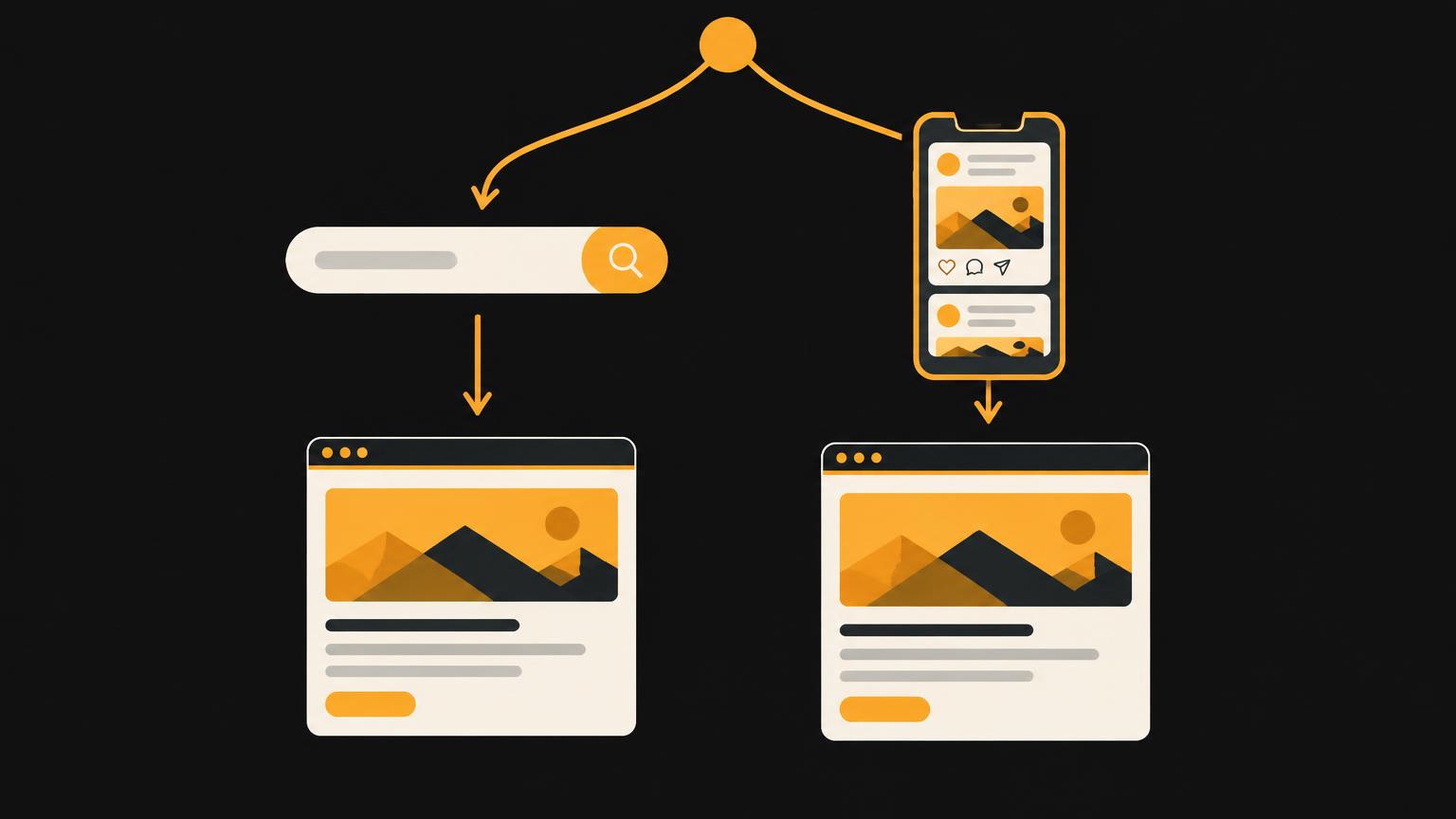
The accompanying graphic compares two routes: Google search, relevant search ad, landing page, possible enquiry; and Meta feed, attention-grabbing ad, landing page, possible enquiry. These routes are schematic. People may switch between channels, return later or leave without enquiring. The illustration does not claim that this sequence is certain or that a single interaction will have a particular effect.
[Enquire about a marketing project](/anfrage/marketing) and assess together which channels suit your starting point; preferred preselection in the form: multiple.
Send a non - binding enquiryA campaign objective needs a sound approach to measurement
Before launching, define which action is genuinely useful to your business. A page visit may be an intermediate step, while a relevant enquiry may be a more advanced objective. The two should not be given equal weight. Also describe how you recognise an unsuitable enquiry and how enquiries are handled within the business.
Meta explains how to choose an advertising objective in its official guidance on ad objectives. The version reviewed here is served in Swedish. The available objectives and their specific configuration must be checked in the relevant account before implementation. Choosing an appropriate objective is no substitute for good content or a suitable landing page.
Tracking may only be used with appropriate consent and a suitable data protection solution. Clarify which events should be recorded, who will have access and how consent will be taken into account. Server-side transmission or a Conversions API is not a way to bypass these requirements. Gaps in measurement and differences in the platforms’ attribution must be included in the evaluation.
Compare platform reports with the enquiries actually received and handled. An attributed target action is not automatically a new order. The article on conversion tracking explains the basics. Document changes so that subsequent differences are not hastily attributed to a single measure.
Plan budgets and combined channels around what you can deliver
The advertising budget goes to the platform. Strategy, setup, copy, images, videos, landing pages and ongoing management are separate services. Platform costs and advertising spend are paid directly or in accordance with the account setup; responsibility for these payments must be confirmed before the project begins. Ask which services are included in a plan and which are not.
A combination is not automatically more comprehensive or effective. It requires enough content, clear responsibilities and the ability to assess results from both channels together. If the available budget is spread across too many tasks, the evaluation may tell you little. A limited, clearly defined starting point can be more useful than numerous parallel campaigns with no clear question to answer.
Plan a combination around distinct roles: one channel might explain a topic, while another responds to a search made later. This does not establish a guaranteed chain of effects. Combined reports should account for double counting and different attribution methods. The article on online advertising costs explains the separate cost categories you need to consider.
An interactive channel selector to prepare for a discussion
In the example, select your offering, observable demand, audience, existing content, objective and typical purchasing decision. The selection is designed to highlight unanswered questions. It provides neither a definitive channel recommendation nor a forecast of clicks, enquiries or sales.
- Which search terms do potential customers use, and does your landing page match them precisely?
- Which images or videos could be prepared for feed formats?
- How local is the service area, and how is the region targeted in campaigns?
- What information do potential customers need before making an enquiry?
- Wie wird «Anfragen» mit Einwilligung gemessen?
Where there is active demand, for example, you would need to check which search terms are relevant to your offering and which landing page answers them. For an offering that needs explanation, existing visual concepts and the clarity of the message would be important areas to assess. If both channels emerge as possibilities, workload, consent, measurement and responsibilities still need to be clarified individually.
These documents and answers make choosing a channel easier
- Describe your offering, service area and available capacity.
- Collect typical audience questions and barriers to making a decision.
- Identify existing accounts, access permissions and the people responsible.
- Check which images, videos and copy you can use, and the rights to them.
- Clarify the landing page, form and process for handling incoming enquiries.
- Agree on consent, the data protection solution and the events you want to measure.
- Define the advertising budget, scope of services and approvals separately.
Ask for a clear explanation of the proposed selection. Good planning also identifies uncertainties and reasons not to launch a campaign yet. If content is missing or enquiries cannot be handled internally, these prerequisites should be addressed first. A platform cannot compensate for such organisational gaps.
Summary
- Search ads can respond to existing search intent; Meta ads can introduce an offering through discovery.
- Your offering, audience, content and purchasing decision determine the questions worth assessing.
- Both channels need suitable landing pages and clear objectives.
- Advertising budgets and services must be planned separately.
- A combination requires joint evaluation and clear responsibilities.
Frequently asked questions
Is Google Ads fundamentally better than Meta Ads?
No. Suitability depends on demand, your offering, your audience and the content available. Compare specific campaign roles rather than making blanket judgements about platforms.
Are Meta Ads suitable for services?
Services can be explained through clear examples of their use and processes. Whether Meta is suitable also depends on your audience’s existing knowledge and purchasing decision.
Can a local business use both channels?
In principle, yes. However, the service area, available capacity and the location settings available on each platform must be checked before implementation.
Do I need the same content for both channels?
The core message should be consistent. However, imagery, copy and the amount of information must suit the way people first encounter the offering and what they already know.
Does a higher budget guarantee more relevant enquiries?
No. Your offering, competition, landing page and measurement also influence results. A budget should be assessed against clear tasks and constraints your business can manage.
What information is needed during preparation?
You should provide objectives, regions, capacity, content and account access. Specialist approvals and information about consent and the enquiry process are also required.
Sources
- Refine new keyword ideas in Keyword Planner - Google Ads Help Google · checked on 2026 - 11 - 05
- How to choose the right ad objective in Meta Ads Manager | Meta Business Help CentreMeta · checked on 2026 - 11 - 05
- Manage spending in Google Ads - Google Ads Help Google · checked on 2026 - 11 - 05
Back to the top of the article