
SEO and visibility · SEO and visibility
Regional pages for SEO: when are local pages useful?
A separate page for every city initially sounds like a way to gain more visibility. Yet a collection of almost identical texts does not answer any additional questions. If only the place name changes, visitors gain little additional value. What matters is not the number of regional pages you have, but whether each one clearly explains a genuine service for an area you actually serve.
Regional pages can be useful when audiences, processes or the information required differ. However, they can also split a shared service page unnecessarily. This guide helps you distinguish between city and canton pages, provide honest location details and connect technical decisions with editorial quality. The examples are hypothetical and contain neither client results nor promises about search rankings.
1. Assess regional search intent before deciding on page numbers
Start with your customers’ questions, not a list of every municipality. Is someone looking for a business with a location they can actually visit? Do they need an on-site service, a delivery or advice that can be provided entirely remotely? These situations require different information. A city name in the page title does not explain how working with you in that city actually works.
Gather specific questions from conversations, contact enquiries and existing search data. If questions about your service area come up repeatedly, for example, a clear overview of the area may be more useful than numerous subpages. If people are looking for different local procedures, a more precise distinction may be worthwhile. Always check whether your information genuinely meets the presumed search intent rather than merely containing a relevant word.
The overview of local SEO for Swiss businesses places regional content within the broader context of local visibility. A regional page is just one possible component. It replaces neither a clearly explained service nor accurate contact details. Organic search results must also be distinguished from paid advertisements; an additional page does not buy you a position.
2. Explain your service area and location honestly
Only describe areas where you can actually provide the service offered. Clarify internally which municipalities you serve regularly, where an initial assessment is needed and whether certain work can only be carried out remotely. This distinction is more helpful than a blanket claim that you are available everywhere. State conditions as specifically as you can reliably commit to them.
An area you serve is not a business location. Do not write about an office in a city if you have neither a corresponding location nor an actual point of contact there. Maps, addresses, images and contact labels must also reflect reality. A central telephone number is not a problem, provided you do not use it to suggest a fictitious local branch.
Assign responsibility for keeping this information up to date. Service areas can change, and an outdated promise leads to avoidable follow-up questions. If regional services are only available subject to capacity, explain how availability is checked. A factual limitation is more useful to prospective customers than a broad claim about coverage that has to be withdrawn in the subsequent conversation.
3. City page, canton page or shared service page?
The general service page explains the offering regardless of location: audience, scope of service, requirements and next step. A canton page can add an explanation of how service provision is organised across a larger area. A city page, in turn, needs a more specific information requirement. These levels can refer to one another, but should not repeat the same complete text in a slightly different order.
| Page type | Search intent | Distinct content required | Risk if similar |
|---|---|---|---|
| Service page | Understand the offering | Scope, process and requirements | Regional versions repeat the offering |
| Canton page | Clarify service provision in the area | Area boundaries and regional organisation | Overlap with all city pages |
| City page | Answer a local question | Actual local processes and answers | Only the place name differs |
| Service area overview | Check availability | Locations served and how to check availability | Confusing collection of arbitrary location links |
Decide based on content, not a rigid hierarchy. If the same conditions apply to several cities and no additional questions can be answered, a shared area page may be enough. A larger city does not automatically need its own URL. Conversely, a smaller municipality may have a distinct information requirement if genuinely different conditions apply to your service there.
4. Develop distinct regional value
Differences come from reliable information. Explain, for example, how an on-site appointment is prepared, which documents are needed in advance and who answers regional enquiries. Not every sentence has to be unique. General service descriptions will naturally be similar. However, the page as a whole should fulfil a clear additional purpose that the general service page does not already cover in full.
Consider different audiences too. A business with several properties under management may have different organisational questions from a private individual with a single appointment. These differences only justify regional content if they genuinely relate to the area. Otherwise, a general difference between audiences belongs on an appropriate service page rather than in an artificially local variation.
Only use regional examples if their basis can be verified, or explicitly label them as hypothetical. Arbitrary local history rarely establishes a connection with your offering. Instead, ask: what decision can an interested person make more confidently after reading this paragraph? If there is no clear answer, the paragraph is probably not sufficient justification for a separate page.
5. Build a clear structure with distinct linking paths
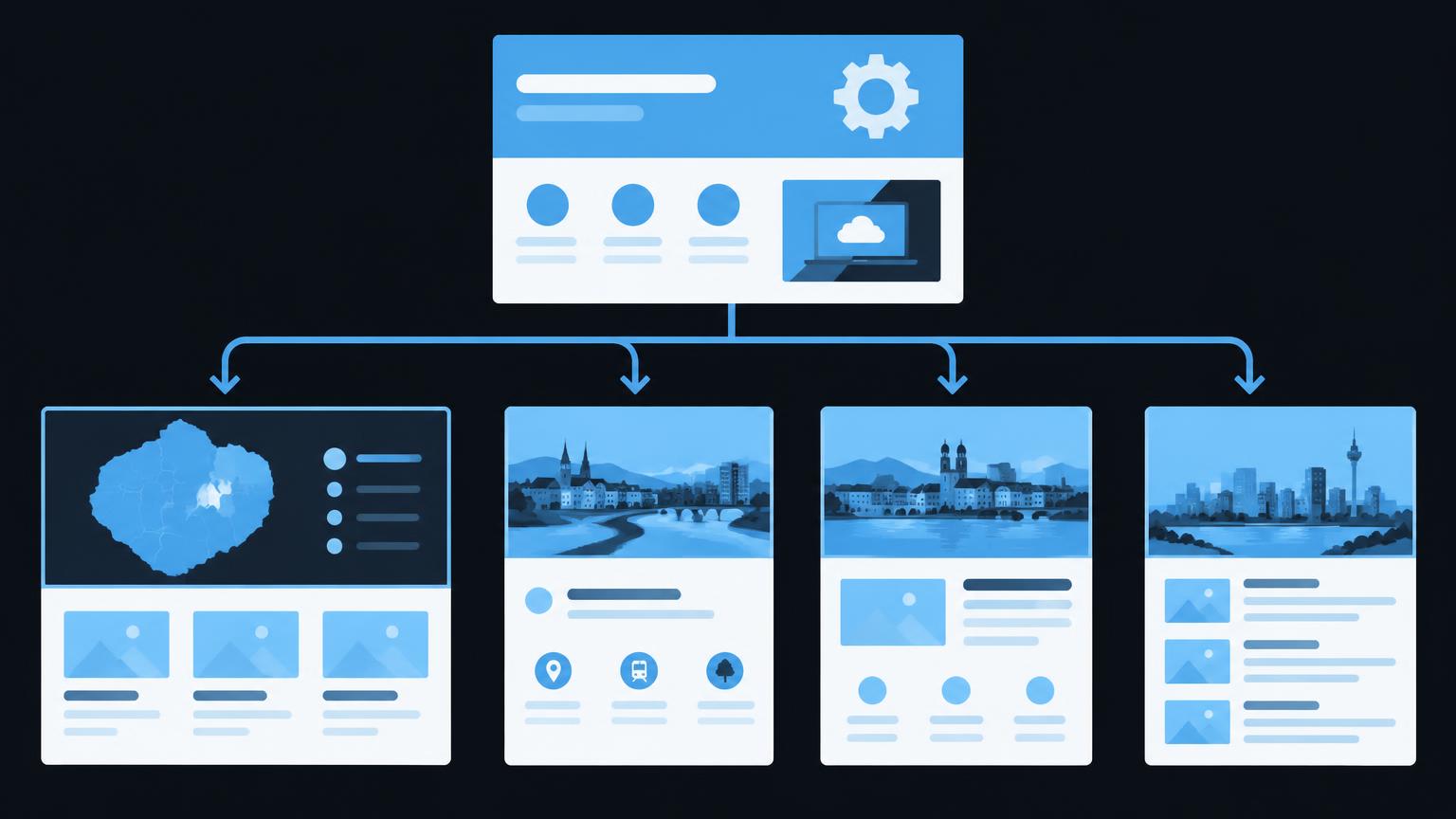
The accompanying diagram shows a general service page, a canton page beneath it and selected city pages beneath that. The connections represent a clear distinction between topics, not a requirement to create every level. The service page answers what is offered, the canton page explains regional organisation and a city page adds specific local questions. If there are no such questions, leave out that level.
Link to the service area overview from a suitable place on the service page. On regional pages, a clearly labelled link leads back to the detailed offering. Relevant city pages can appear within the corresponding area overview. However, avoid long lists of locations on every individual page if they crowd out the text and do not support a useful decision.
The article on internal linking explains how navigation and contextual links work together. Choose anchor text that describes the destination. A regional enquiry should not take someone through several almost identical pages before the scope of service and contact options even become visible. Check these paths from the perspective of someone arriving directly on a city page too.
6. Identify overlaps using a local demo
For each planned page, record the region, the relevant service, the main question and the distinct content already available. Then compare the entries. If two pages answer the same question for the same audience under identical conditions, a shared solution is more likely to make sense. Different place names alone do not provide a sufficient substantive distinction.
In the local page structure demo, you select example regions, services and existing distinct content. The model highlights possible overlaps and shows where a shared page or a clearer distinction would be worth considering. It is an editorial decision aid, not a scan, a real search query or a prediction of indexing. It does not publish anything automatically.
Discuss the output with the person who actually organises your service. A distinction that appears sensible may be wrong in practice if the same process applies everywhere. Conversely, a previously overlooked regional requirement may justify a separate section. Record the decision and its reasoning so that later additions do not turn the structure back into a collection of largely interchangeable pages.
Have your regional pages and their associated SEO structure reviewed for usefulness and overlaps with a [website analysis](/anfrage/website - analyse).
Send a non - binding enquiry7. Distinguish duplicate content, doorway pages and mass production
Duplicate content is not automatically spam. Recurring information about contact details, services or conditions often cannot sensibly be worded entirely differently. Planning becomes problematic when many pages are intended merely to capture different search queries and then lead to a practically identical destination without making a useful, distinct contribution themselves.
The official Google spam policies describe doorway abuse and scaled content abuse. What matters is not simply whether texts were produced manually or automatically. One central consideration is whether pages are created primarily to manipulate search results rather than help people. Varying the wording alone does not turn an automatically populated location template into a high-quality regional information page.
Avoid producing pages by multiplying each service by every municipality. First review a few representative cases and decide which pages are genuinely needed. If there is little distinct content available, merging pages may be the better approach. Support with search engine optimisation should include these structural decisions rather than simply delivering additional texts or URLs.
8. Align merging decisions, canonicals and metadata
When merging pages, first establish which content should be retained and which destination best meets the original search intent. If public URLs already exist, incoming links and appropriate redirects must also be considered. Do not arbitrarily redirect all removed location pages to the homepage. Wherever possible, a redirect should lead to a replacement with relevant content.
The Google documentation on canonicals explains signals used to select a preferred URL for duplicate or very similar content. A canonical is not a tool that turns weak regional texts into good pages. If a city page is to exist independently, it needs a corresponding purpose. A self-referencing canonical can specify the preferred URL, but does not guarantee that Google will select it.
Write a suitable title and factual meta description for every genuinely distinct page. Describe the service and regional characteristics without implying unsubstantiated proximity or a local branch. Different metadata alone does not resolve overlapping content. Review the heading, visible text, internal links and canonical together too, so that these signals do not send conflicting messages about the page’s purpose.
9. Make deliberate decisions about sitemaps and indexing
Only after the quality review should you decide which pages will be publicly accessible and intended for indexing. Private drafts do not belong in public navigation or a sitemap. Preview protection must be technically reliable; a simple instruction to search engines is no substitute for access control. The public URL of an article that is not yet available must not accidentally serve the draft.
In its introduction to sitemaps, Google explains that a sitemap can help with URL discovery without guaranteeing crawling or indexing. It does not replace clear internal links. Include only the intended preferred public URLs and check that they are accessible and consistent with your other indexing signals.
Following subsequent publication, you can inspect the status of important pages and monitor search queries in Search Console. A page that has not yet been indexed is not automatically evidence of a content problem; first investigate the specific technical findings. Equally, indexing does not prove business value. Assess whether relevant visitors find the regional information and can reach a useful next step.
10. Review quality before every publication
Approving a regional page
- The service area is genuinely covered and has been confirmed internally.
- A distinct local question is clearly identified.
- Locations, images and contact details reflect reality.
- Processes and regional limitations have been checked.
- Overlaps with service, canton and city pages have been assessed.
- The title, description and canonical match the decision.
- Internal linking paths and destination URLs work.
- The public sitemap and indexing settings are only updated after approval.
- A designated person takes responsibility for ongoing maintenance.
Do not assess the finished page by its text length alone. Ask someone unfamiliar with the project to explain which service is offered in which area and how to make an enquiry. If they have to compare several pages to understand basic conditions, a clear shared overview may be missing. Also test whether tables and navigation remain readable on small screens without horizontal overflow.
As part of a website improvement, existing area pages can be revised alongside the offering and user journeys. Prioritise incorrect information, unclear responsibilities and unnecessary duplication over cosmetic variations in wording. After making changes, check both the affected destinations and their incoming links. Good regional content makes decisions easier; it cannot promise a particular position or guaranteed inclusion in search systems.
Summary
- Plan regional pages around actual questions rather than lists of locations.
- Distinguish between an area you serve and an actual business location.
- Every additional page needs a clear, distinct purpose.
- Avoid interchangeable templates and artificially inflated page numbers.
- Align merging decisions, canonicals, metadata and links.
- Publish only after editorial and technical approval.
Frequently asked questions
Does every city need its own regional page?
No. A shared service area overview may be sufficient if the same conditions apply everywhere. Separate pages are particularly useful when they answer additional local questions.
Can a page describe an area where you do not have your own office?
Yes, provided you actually serve the area and explain the situation honestly. However, an area you serve must not be presented as a fictitious business location. Make clear where your business can actually be reached.
Are recurring service descriptions prohibited?
No. Factually identical information does not need to be artificially rewritten. However, check whether the additional page still fulfils a distinct purpose overall.
Does a canonical resolve every overlap?
No. It is a signal indicating the preferred URL for identical or very similar content. It does not compensate for a lack of regional value or an unclear information structure.
When should city pages be merged?
When they answer the same question under the same conditions and provide little distinct information. Review existing content and links before merging. Decide on appropriate technical handling for URLs that were previously public.
Does a sitemap guarantee indexing?
No. It can help with URL discovery. Accessibility, content quality and clear internal linking must be checked independently.
Sources
- Spam Policies for Google Web Search | Google Search Central | Documentation | Google for DevelopersGoogle · checked on 2026 - 11 - 05
- How to Specify a Canonical with rel="canonical" and Other Methods | Google Search Central | Documentation | Google for DevelopersGoogle · checked on 2026 - 11 - 05
- What Is a Sitemap | Google Search Central | Documentation | Google for DevelopersGoogle · checked on 2026 - 11 - 05
Back to the top of the article